Saturday, July 26, 2014

Set #5


Appelt, K. (2008). The underneath.  NY:  Simon and Schuster.

     Underneath features a pregnant cat that has been abandoned alongside the side of the road. The story is set in the East Texas/Louisiana swamp region where the lonely cat wanders through the forest in a thunderstorm. The storm has unlocked a mysterious jar containing Grandmother Moccasin who also thinks, has feelings, and talks like the other animals. Grandmother also has her own subplot of love, revenge, and loneliness which adds to the ironic twist at the end of the tale. The calico cat befriends Ranger, a dog who has been chained to the porch by his cruel master Gar-Face. Using the advice of Ranger, the cat and her kittens hide underneath the porch, so that they won't become alligator bait. However, Puck, the male kitten, wanders out and is caught by Gar-Face which leads to Puck's narrow escape and the death of his mother. Before the mother dies, she makes Puck promise to go back and free Ranger and care for his sister. The reader can easily identify with the characters struggle to survive and the characters need to form family bonds especially as the reader watches the young kittens mature. The style of the story is appealing with its use of onomatopoeia, similes, repetition, rhetorical questions, telegraphic sentences, and anthropomorphism which create a lighthearted, suspenseful tone. Students could research swamp animals, or perhaps explore what family means after reading this book.

Gaiman, N. (2008). The graveyard book. NY:  HarperCollins.


    Neil Gaiman’s Graveyard Book begins with action and suspense as a knife wielding murderer named Jack wanders through a household killing all the family members except an eighteen month old infant. The infant wanders off into a graveyard where the graveyard people vote to protect and raise the boy. They name the boy Nobody (Bod) Owens. The boy experiences all types of encounters as he grows into a man which include being educated by a werewolf, captured by ghouls, locked up by treasure seekers, and captured by five murderers. After surviving all of these encounters, he comes of age where he can no longer live in the graveyard, and his guardian sends him off into the world. Gaiman creates a suspense filled plot by including elements that help to set the Gothic tone by creating shady characters such as ghouls, a witch, a werewolf, and ghosts.  The setting of the graveyard permeates throughout the story establishing a suspenseful, eerie tone and advancing the plot.  The story is told in third person omniscient where the narrator has the ability to tell all or slowly reveal secrets.  Students could write or tell their own ghost story using some of the elements found in this tale.

Hale, S. (2008). Rapunzel's revenge. NY: Bloomsbury.

      Rapunzel’s Revenge  is a fantasy, graphic novel that is loosely based on the old, familiar fairy tale. Rapunzel is raised by a witch and locked up. In this retelling, Rapunzel lets down her hair and escapes with a boy named Jack. Jack’s only possessions are his bean and goose. The two of them take revenge on Rapunzel’s witch mother Gothel and set out to free her real mother and right wrongs.  Along the way they meet some intriguing characters and battle a sea serpent, a boar, a coyote, and kidnappers. They end up in jail, but escape.  The tale includes a number of references to traditional fairy tales, but adds its own twist such as its Western setting and dialogue filled with sarcasm.  The book includes simple, yet tasteful illustrations. The theme of right prevails. Students could use this opportunity as a chance to tell their own version of a fairy tale.
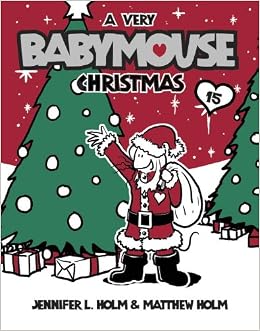


Holm, J & M.  A very Babymouse Christmas.  NY:  Random House.


         A Very BABYMOUSE Christmas incorporates several familiar Christmas stories and traditions into a new tale where the main character is obsessed with getting a Whiz Bang as a Christmas gift. The familiar stories include: "'Twas the night before Christmas..., "Rudolph the Red-nosed Reindeer, the Nutcracker, and How the Grinch Stole Christmas. The author includes traditions such as leaving cookies out for Santa and Christmas decorating contests. All of this is presented in a comic format. Babymouse eventually learns the lesson that sometimes the best gifts are the ones that you did not even know that you wanted. At the end of the story, Babymouse not only learns a lesson, but grows as a character when he gives the narrator a present. The Christmas setting is believable because of all the familiar traditions, and the universal theme learned indicates that good does win over evil thoughts of selfishness and greed. This tale could be paired up with some of the familiar stories such as A Christmas Carol or How the Grinch Stole Christmas.


   Landry, D. (2007). SkulduggeryPleasant  NY:  HarperCollins.

Skuldugger Pleasant, set in Ireland, begins with the death of Gordon Edgley, an author of horror stories and Stephanie Edgley’s uncle. Stephanie at the time of his death is only twelve, but she is to inherit all of his property and possessions when she turns eighteen. The first night that she stays alone in the house, a stranger breaks in and demands that she give him a key. Stephanie is rescued by Skulduggery Pleasant who bursts in the front door and scuffles with the man, throwing fire balls at him, and finally chases him out with a bullet in his shoulder. This is when Stephanie discovers that the skeleton man that rescued her has only a skull for a head.  Stephanie learns that her Uncle Gordon’s horror tales for the most part were true, and the uncle and Skulduggery were friends.  Stephanie becomes Skulduggery’s partner fighting against evil. The author creates multidimensional characters as Stephanie is mentored by Skulduggery. The plot is fast paced as the two search for the Sceptre of the Ancients in the maze beneath the house that Stephanie inherits trying to prevent the antagonist, Nefarian Serpine, from obtaining it first. Stephanie ends up being captured by Serpine, but is freed by Skulduggery because the theme of good wins over evil prevails.  Stephanie learns in the end that she too has magical powers, but she must choose a name to keep these powers.  This story could be easily plotted on a chart, and students could study the elements of a plot.


Selznick, B. (2007). The invention of Hugo Cabret  NY:  Scholastic.

The opening setting of The Invention of Hugo Cabret is a train station in Paris in 1931. The story begins with a series of penciled drawings that establish the setting of the story, and these drawings become an integral part of the story telling process. Hugo, a twelve year old orphan boy, lives behind the walls of the train station where he works on clocks and mechanisms. He is caught stealing toys, and he is forced to empty his pockets which include his prized notebook. The old man, Papa Georges (Georges Melies) plans to burn the notebook. Hugo follows him home only to be shut out by the old man, so Hugo throws a rock at the window and a girl appears in a window reassuring Hugo that Papa Georges will not burn the notebook. Through a flashback the audience learns how Hugo’s father died. Hugo visits the old man at the toy counter, and the man puts him to work fixing broken toys. While working there, Hugo meets a young man named Etienne, and he learns that the girl in the window is Isabelle. Etienne sneaks Isabelle into the movies because Papa Georges won’t let her go. Hugo eventually learns the old man’s true identity and his secrets about movies. Hugo becomes part of the family when the train inspector threatens to send Hugo to jail. The story is a coming of age story where Hugo grows up and makes his own automation which writes this book, and Isabelle’s key unlocks it and draws a picture and signs it Georges Melies (who is actually a famous filmmaker). The setting is one of confinement. Train stations are where people go if they want to go places, but not for Hugo because he is confined to the walls of the station with few friends. Isabelle is an orphan as well who is confined. Themes of isolation and friendship move throughout the story. This story has been made into a movie. Teachers might want to compare and contrast the film and novel.


Krocoszka, J. Lunch lady. NY: Random House.

         Lunch Lady and the League of Librarians is a graphic, comic tale set in school. Dee, Hector, and Terrence are the "good guys" known as the Breakfast Bunch of students. They overhear the League of Librarians plotting to steal the fundraising money and destroy the X-Station 5000 game. The students report it to the Lunch Lady and her bunch who are actually crime busters in disguise. The Lunch Lady and her bunch investigate and apprehend the League of Librarians. The theme of good wins over evil emerges along with some other underlying minor lessons about bullying and working collaboratively in a group. The dialogue helps to create a fast paced, suspenseful plot that is consistent with a typical hero story. Of course, the dialogue also contains the typical hero style onomatopoeia words of action. This book could lead into classical hero stories, or a discussion of real life contemporary heroes.


  Willems, M. (2013). A big guy took my ball! NY: Hyperion

     In this story, Piggie has fun playing with a ball that he found, but he becomes distraught when a big guy takes it away. Piggie tells Gerald what happened, and Gerald becomes upset to think that someone bigger took Piggie's ball away. Gerald promises to get the ball back, but he gets scared and runs back to Piggie without the ball when Gerald finds out that the big guy is much bigger than himself. Gerald musters up the courage to confront the big whale a second time, and surprisingly, the whale thanks Gerald for finding his ball. The whale tells Gerald that no one will play with him because he is big. The audience can identify with this simple scenario; the theme is universal. People should not draw conclusions or stereotype big or little guys. The setting of the story is not overtly evident, but could be the typical modern day playground. The author's style uses repetition, telegraphic sentences, simple words, all caps on some words, and simple questions to create a simple, powerful story with a light touch of humor. The characters talk and express their true feelings in a simple and easy to follow plot which helps to make the characters believable, and someone everyone can relate to. This book could be used as an opener for teaching young children about stereotyping.


Wednesday, July 23, 2014

Set #4


 Curtis, C. P. (1995).   The Watsons go to Birmingham, 1963.  NY:  Delacorte.

In this historical fiction story, the Watsons decide it is time to visit Grandma in Alabama. Byron, the oldest son, is a trouble maker and if he does not straighten out, he will be living with his strict Grandma. While visiting grandma, Kenny almost gets taken in by the whirlpool he was not suppose to go near. Luckily, Byron saves him. One day (while still at Grandma's), little Joey goes to church with a neighbor. The church gets bombed (racism), and everyone in the family rushes to go find her. She is not there, but when they return home, Joey is at home looking for them. Joey had left the church before the bombing. Even though Joey is okay, Kenny has a hard time dealing with everything going on; he even hides and won't talk to anyone. Byron (changed) talks to Kenny trying to make him feel better. Finally, Kenny accepts that the world is not perfect. The narrative is through the point of view of Kenny, who has a tough time dealing with the racism during the time period. This is believable for a boy his age going through these tough and not easily understandable times of the 1960s. The setting, Birmingham, Alabama, is authentic in this story. The bombing described really did happen on September 15, 1963 in Birmingham, Alabama. After reading this book with the class, research should be done on other types of segregation/racism hatred, what laws were passed to stop this, and what famous leaders tried to stop the hatred.  


Nelson, K. (2008). We are the ship  NY:  Hyperion.

We Are the Ship tells the story of what it was like to play Negro League baseball.  A generic narrator is used to tell the story beginning with 1920 and moving to 1947 when Jackie Robinson moved into the major leagues.  The characters are believable because the author has included powerful oil paintings that express the emotional feelings of the players themselves.  He also adds quotes from famous names in baseball that authenticate his voice.Teachers might want to have students visit a museum which could be done as a virtual field trip, or they might raise a question about other minorities in other sports.


Schlitz, L. A. (2007). Good masters, sweet ladies  Boston, MA:  Candlewick Press.


Laura Amy Schlitz’s Good Masters! Sweet Ladies! Voices from a Medieval Village consists of a series of miniature stories set in England in 1255. This setting establishes the realistic backdrop for Schlitz’s style which is mostly verse, songs, and some prose. Each story has its own plot with realistic sounding characters from the Medieval period. Sprinkled throughout are just enough factual details to make the stories sound authentic. For example, she writes of Saint Winifred’s well and the healing power of the well, and of characters like Simon who wanted to fight in the Crusades, but he ends up becoming a monk because of money. The author tells Hugo’s tale of killing a boar and the nightmares that follow. All of the characters have a voice that seems appropriate for the Medieval setting. This book is sure to spark interest in the students, so have students research a topic in Medieval times. 

Monday, July 21, 2014

Set #3

Cleary, B. (1983).  Dear Mr. Henshaw. New York, New York:  Morrow.

     Leigh Botts writes letters to his favorite author, Mr. Henshaw. When Leigh writes the author a series of questions for his research paper, Mr. Henshaw writes Leigh questions for Leigh to answer. His mom makes him respond to the questions. When Leigh responds to the questions, his personal life and emotions come out like his parent's divorce and his relationship with his father. Leigh is also having trouble adapting to being the new kid at school. The author encourages Leigh to write in a diary, and the writing switches over to a diary/journal format. Through his writing he learns to deal with the problems he is facing. Students can easily relate to Leigh because he struggles with the same issues students of the present-day face- divorce, raised by one parent, and other kids being mean. This makes students want to read this book to see how Leigh handles it. The style of letters and then switching to diary/journal format helps students easily follow along, and students do not feel like they are reading another long chapter book. Instead, the set up makes the reading go by faster with the letters and journal entries. While reading this book, I would encourage students to keep a journal or diary to write down their personal thoughts every day. I also think it would be fun to have students write or email their favorite author after reading this book. 


 Draper, S. (2010).  Out of my mind. New York, New York: Atheneum.

     Melody has cerebral palsy making her not be able to walk or talk. Even though she cannot do things a normal eleven year old can do, she is incredibly smart. She dislikes being in her special education class because she is intelligent and wants to be challenged. Melody has always wanted to be able to communicate what she feels. Finally, her dreams come true with a Medi-talker. With her thumb touch, a computerized voice (she names Trish) can speak what Melody would like to say. Melody is able to communicate things like, "I love you" with her parents, and is able to show how smart she really is. The classmates are not the nicest to Melody, and Melody must stay strong. One day, Melody tries to communicate to her mom that she is about to back into her baby sister, but her mom does not understand why Melody is screaming. Her mom hits Penny, and Penny is rushed to the hospital. Penny survives, and Melody is seen as a life saver to Penny. This female protagonist, despite her disability, is a strong leader who believes in herself, and is always trying to be the best that she can be. The themes of the story are not overpowering, but one theme clearly explains the message that it is important to believe in yourself and never give up. The contemporary setting are school and home in present time for Melody. Melody is in a setting that all students can easily relate to. A great journal writing to follow this story would be to explain a time when you stood up for you believed in or a time you really believed in yourself. 


Kinney, J. (2007).  Diary of a wimpy kid  New York, New York:  Amulet Books. 

      Greg Heffley is entering middle school where he wants to be the popular kid. Greg and his friend, Rowley, have lots of adventures together like wrestling team (Greg is not as big as the other kids), Halloween (getting chased by older kids), safety patrol (Greg eventually gets kicked off), and Rowley gets picked to draw the comic section in the school newspaper. Rowley and Greg start fighting because Greg lies about the safety patrol and has Rowley take the blame. The teenagers who chased them on Halloween come back and make Rowley eat the forbidden cheese touch (will doom your popularity forever). The next day, Greg takes one for the team and says he ate the cheese touch (dooming himself). Greg and Rowley make up, and all is well at the end of the first book of the series. Greg is a believable character that all children can relate to, and he goes through the same things a middle schooler would. He has trouble with his best friend, he wants to be popular or class clown in the yearbook, and he is afraid of his older brother and fights with his younger brother. The setting is realistic, as well. It mostly takes place at school and home. These common settings can help students visualize and relate what is happening to Greg. The setting is believable and accurate because all of the things that happen to Greg at school could easily happen to students. Students love the illustrations (comic drawings) Jeff Kinney uses in this book. Have the students create a comic strip of something they believe will happen to Greg next year.


Lord, C. (2008). Rules. New York, New York:  Scholastic.

     In Rules, Catherine has a hard time dealing with her brother, David, who has autism. She makes rules for David, so he can function in society like no toys in the fish tank, open closet doors carefully, something may fall out, and no pulling down your pants unless mom, dad, or a doctor tells you to. Catherine meets Jason (who is in a wheelchair and cannot speak and instead points to words to communicate) at David's OT appointments, and they soon form a friendship. His disability hinders her from going with him to the dance. Catherine realizes she must get overcome her embarrassment of Jason and David, and it is okay to break pointless rules. This book is a great book for students dealing with someone in their family that has a disability. As well, it is great for any student to read and learn about others with a disability. The main character is a female, and her gender (female) has to become the strong leader by the end of the book. She must be the babysitter and learn to be selfless because her brother comes first in lots of cases. The plot is plausible and engaging. Catherine struggles with the embarrassment of her brother, and this takes a big effect on her life like making new friends. At the same time, she does like any sibling would, she defends her brother at all times. The author does not make it easier for Catherine by making the conflict of David go away, but instead has Catherine deal with her problems. The creative style makes readers want to keep turning the pages. Every chapter is titled with a rule that Catherine has made for her brother, David. Catherine also uses rules in her head to deal with problems that she encounters. The rules also foreshadow something that will happen in the story which in turn makes the reader curious to read what will happen. A great activity to go with this book would be for students to pick seven words they feel are most important and that they use every day. Then on flashcards, write the words and illustrate each word like Catherine does for Jason in his communication book.


Paterson, K. (1972). Bridge to Terabithia. New York, New York: Crown.

     Jess was a fast runner and practiced his running a lot. He had many struggles of a teenage boy with bullying from other students, pressures of his home life, and living with his sisters. Jess loses the race at school to the new kid at school, Leslie. At first, he does not like Jess, but soon he takes a liking to the misfit, Leslie. Leslie and Jess start spending lots of time together, and they make up an imaginary place called Terabithia. They get lost in their imaginary world, and have a bonding friendship. One day after being gone on a trip with his teacher, Miss Edmunds, Jess returns home to find out his friend has been in a deathly accident (the rope broke and she drowned in the water). He is overtaken by grief and has a hard time dealing with Leslie's death. Finally, after finding his sister in "their place" (Leslie and Jess's place), he overcomes his grief, and he makes his sister the queen of Terabithia. Jess, the main character, has weaknesses (overcoming his pride that a girl beat him in a foot race) and strengths (befriends the outcast when others do not). This is a characteristic that all people have (faults and strengths). Being able to relate to the character makes the reader more likely to enjoy this book. The hard concept of death is dealt with in this book (a reason this book is censored a lot), and for students dealing with death at a young age, this is a great book to turn to and read. This book also looks at gender in a different way. Females are not suppose to be athletic (Leslie is) and males are not suppose to be artistic (Jess is). It steps away from the stereotyping of boys and girls. After reading this story, it would be a good time to bring up one of those hard topics of death and how to handle it discussions with the students.

Saturday, July 19, 2014

Set #2

Bishop, N. (2007). Spiders. New York, New York: Scholastic.

In this book, basic information and facts are given about spiders. It talks about what they eat, their web, how they digest their food, and how they catch their food. He uses vocabulary words associated with spiders, and he even defines these words in the glossary in the back of the book. His photography of all the different kinds of spiders is amazing. Bishop's accuracy in the book makes it a good book to share with students, especially if you read it before you do a lesson on spiders. He takes all of the photos himself, and lists the names of each spider he takes a picture of. It is published by Scholastic giving it credibility to use in schools based on Scholastic's outstanding reputation with schools.

Garza, C. L. (1999). Magic windows. San Francisco, CA: Children's Book Press.

Magic Windows is an informational book that features cut-paper art that the narrator has been making for twenty-seven years. She has become an expert in her field. To the narrator, these are “magic windows” that expose another world. The colors, headings, and overall layout enhance the “magical windows” appearance. Not only is the book attractive in its layout, but it also gives an explanation and background along with an illustration of the cut-paper art. Each explanation is given in Spanish as well as English. The reader learns about the emotional attachment the narrator has to the cut-paper, but the reader also learns about many of the traditions and beliefs found in the culture of the Spanish people. 

 Harris, R. (1999).  It’s so amazing.  Boston, MA:  Candlewick Press.

This book goes through all the details of how a baby is made, grows inside, labor, and after the baby is born. It even explains adoption. It ends with celebrating your birth day or adoption day. This book is organized in sequential order of how a baby is made all the way to the delivery. The organization makes it easier to understand the process. The colorful design with pictures, descriptions, captions, and word blurbs throughout the book make it easy to follow along. One of the pictures illustrated is actually the actual size of a nine month child in the mom's womb. There is even an index at the back of the book to help locate certain information to be found on a certain page number. The book also proves its authenticity through all the sources listed at the end of the book. Lots of the sources are doctors giving the book credibility. I cannot see this book making it on an elementary library shelf in a school because of the mature content. However, it is a great book to suggest to parents to check out from the public library to read to their children (whatever pages they feel are appropriate) when they are expecting.


Giovanni, N. (2005). Rosa.  NY:  Holt.

This book follows the story of Rosa Parks, and her refusal to get up from her seat on the segregated bus. Rosa stood up for what she believed in- that everyone should be treated equally, and black people should not have to sit in the back of the bus and give up their seats to white people just because of their skin color. The book explains that her refusal helped other black people stand up for what was right. It lead to a non violent movement led by Martin Luther King Junior where finally segregation was considered wrong. The story was organized in sequential order of Rosa Park's refusal to give up her seat first, then other movements were inspired, and lastly segregation was deemed wrong. Correct dates are used like November 13, 1956 it was ruled that segregation on the bus was wrong. This makes the credibility of the book strong when using dates and real facts in the order that they took place. A great book to talk about when discussing the subject of segregation with students. 

Sweet, M. (2011). Balloons over Broadway: The true story of the puppeteer of Macy's parade. NY: Houghton.

Tony Sarg loves puppets. His love of puppets is turned into a job creating the Macy's Thanksgiving Parade. After much experimenting, he finds the perfect solution so everyone can see the parade. He uses huge balloons in fun shapes to rise in the sky at the parade. This tradition still lives on today. This is a great story to read before the Thanksgiving holidays, and it would be fun to encourage students to come up with an idea for a balloon at the Macy's Thanksgiving parade. Sweet does a wonderful job with the style of this book. She makes the nonfiction text a fun story to read about the life of Tony Sarg and the tradition of the Macy's Thanksgiving Parade. The writing is interesting and in a clear vocabulary kids can understand. The design of the story is unique, too, because she uses parts or clippings of older texts and pictures (like old newspaper clippings) with newer pictures that is all mixed in together. At the end, she even includes a bibliography listing her sources for accuracy in the book.

Bragg, G. (2011). How they croaked: The awful ends of the awfully famous. NY: Walker 

The title of the book explains exactly what this book is about. It explains how famous people died or croaked. To name a few, George Washington, Elizabeth I, Cleopatra, Julius Caesar, and Albert Einstein are all written about. It is organized into sections on each person. In the section, it talks about what they did with their life, and how they died. The division of each person with the table of contents at the beginning helps the reader easily find where each famous person's information is located. It would be great to use this in sections if you were talking about a certain person each day. This book has a clever design and style. The pictures created make the famous people really look like they are croaking (sure to make the kids laugh). While the information is accurate, it says the facts in a funny way that makes the reader want to keep reading to see what happens. At the end of the book, there are sources listed for the information presented, additional sources to look for more information, and an index. All which are valuable tools for a teacher to use when teaching one of these famous people.

                                      Bartoletti, S. (2005). Hitler Youth.  NY: Scholastic.

This book tells the stories of some of the youth that belonged to an organization known as Hitler Youth.  It officially formed in 1926 in Nazi Germany giving youth hope and a chance to rebel against those in authority.  The book briefly discusses some of these youth and their role supporting Hitler. The book is well-organized; it includes a table of contents, photos and maps, an epilogue, and timeline. Most importantly it cites sources which indicate its accuracy of information. Students might create a poster that represents some research on other facets of Nazi life, or perhaps, students could Skype with one of the living youth.


Thursday, July 17, 2014

Set #1

Deedy, C. A. (2007). Martina the beautiful cockroach. Atlanta, Georgia: Peachtree Publishers.

Martina, the beautiful cockroach, is ready to marry. Her grandmother gives her advice on how to find the perfect husband- do the coffee test. If they get mad about spilling the coffee on their feet, then they are not the perfect match. Martina tries several suitors, but all fail the test. Finally, she meets Perez, the mouse, who passes the test. Martina finds that Perez is her perfect match. This story is great for ELLs to listen to a story with English and Cuban language. It is good for students who are not ELLs too because it introduces another language in the story, as well. In the story, the illustrator uses a green color to represent the cockroach which implies cool and calm, but uses the red and orange for the rooster to represent the opposite of cool and calm. This makes sense because the rooster was not cool and calm when Martina tried her coffee test (spilling it on his feet). The theme in this story is not overpowering the story, but simply shows that a kind husband will not be mean or yell when accidents happen like spilling the coffee.

 
DePaola, T. (1983). The legend of the bluebonnet. New York, New York: G.P. Putnam's Sons.

The Comanche people had no rain, and drought and famine were hardest on them. The Great Spirits tell the people that a sacrifice of the most valued possession among them must be made because of all the taking from the Earth. She-Who-Is-Alone does the ultimate selfless act by sacrificing her doll (the only thing she has left from her family who died in the famine). After her giving sacrifice, she awakes to bluebonnet flowers (forgiveness) and rain for her people. This is a perfect story to read to your students when bluebonnets start popping up in the spring time. After reading it, you can have students draw a bluebonnet and write a selfless act they have done before. DePaola uses line, shape, color, and texture to unify the pictures. The composition works together to grab your eyes to the beautiful pictures in the story. The main character is a young girl who little children can relate to because she is young and has a doll. She does the ultimate selfless act by giving away her doll creating a lesson of being selfless.

Sendak, M. (1963). Where the wild things are. New York, New York: HarperCollins.

Max (in his wolf costume) gets in trouble for misbehaving, and he is sent to his room without supper. In his room, his fantasy runs wild, and he goes to the jungle where there are "wild things." He soon decides to go home, and when he goes home, supper is waiting for him. The texture created makes the characters seem real like, and Max's imaginations seem true. The pictures are big on the page making the reader feel like they are in the jungle, too. Max is a strong character in this book because he has a creative way of looking at the world, and his imagination reveals his personality, as well. The setting truly comes alive because of the illustrations. After reading this book to a class, ask the students to draw a picture of what they believe would be in their own jungle. This would bring out the personalities of the students like Max's personality was brought out in this story.

Singer, M. (2010). Mirror, mirror. New York, New York: Dutton.

Mirror, Mirror takes a creative spin on fairy tales. The mirror is used to reflect two different pictures and two different sides of the story. When you read the left side, it tells one person's view, and when you read the right side, it tells another person's view. It uses the same set of words, but reads them reversed. It uses different fairy tales like Little Red Riding Hood. On the left side, it says the story of the little girl going through the forest to her grandma's house, and that she must not dawdle. On the right side, it tells the story from the wolf's point of view, and how the little girl skipping through the wolf's hood is a sweet treat while using the same words. This is such a neat idea for a story. The illustrator uses lines to create a mirror of the pictures and words. The mirror line separates the story into two different points of view or ideas. This unique style of the play on words and pictures has the reader laughing and thinking about the story in a different way than ever before. A great activity for students would be to create their own story with words making sense if you read them going up and going down like Singer did in this story.

Wiesner, D. (2001). The Three Pigs. New York, New York: Clarion.

The story starts off like the traditional story of three little pigs, but soon the author puts a twist on the story. The pigs go off to different settings. They do not stay with the wolf instead they are with a dragon and cat and the fiddle in different stories. The story ends with everyone back in the brick house. The pigs get to explore another world and not stick to the traditional world. Children will love getting to read a different tale of the little pigs, and should be encouraged to write their own story of where the pigs might go next. At first, the pictures start off like a cartoon, but then as they leave the original story, the pigs become real-like. This type of illustration really makes the book stand out as unique. Composition really seems to unify the pictures because lines, shapes, colors, and textures play a part in making these illustrations pop. This book gives children the idea that it is okay to deviate from traditional and think outside of the box.

Smith, L. (2011). It's a book. New York, New York: Roaring Brook.

Lane Smith creates a funny story with a monkey, mouse, and donkey. The monkey has a book, and donkey asks lots of questions about this book. Can it text, does it need a password, and do you have to have a screen name are some of the questions donkey asks monkey. Monkey replies over and over that it is a book. Donkey reads it and likes the book. Monkey does not get the book back, but donkey says he will charge it back up for monkey after he is finished with it. This book story can easily be related to all children because children have grown up with technology, and they believe like donkey everything texts, tweets, and needs a screen name/password. Smith uses shapes for the rectangular chairs and the animals bodies. He makes the monkey seem like a big character while the donkey and mouse are smaller. The plot is simple, but believable that the donkey does not understand the simplicity of a book. This could lead into a great discussion of how technology has changed, and a debate if books or ebooks or better.

Klassen, J. (2012). This is not my hat. Boston, MA: Candlewick.

This short book tells a great message. A little fish steals a hat from a big fish, and thinks he can get away with stealing the hat. The little fish explains that the big fish probably won't know it is gone, or who stole it, or where he is going. The little fish is wrong, and the reader can guess from the pictures that he was probably eaten by the big fish. Children can learn to not steal from others in this story, and a great discussion can be started on why you should not steal. The shapes used make the story come alive. The large shape of the big fish and small shape of the little fish help the reader understand exactly how much bigger the big fish was than the small fish. The setting of the story is set up all through the pictures. The seaweed and bubbles help the reader understand the story takes place under the sea.